In Development
Novellas
The Null Point
Short-form transmissions from the edges of the Cycle — case files and side-ledgers that don't fit the main audit. Standalone dread, read in one sitting.
You are tired because you are being hunted.
An alien survey team is sent to audit a dead world. What they find in the ledgers is not a war, not a plague, not a machine that woke up. They find a shape — something that fed on a civilization without ever having a body. You already know its name. You simply call it something else.
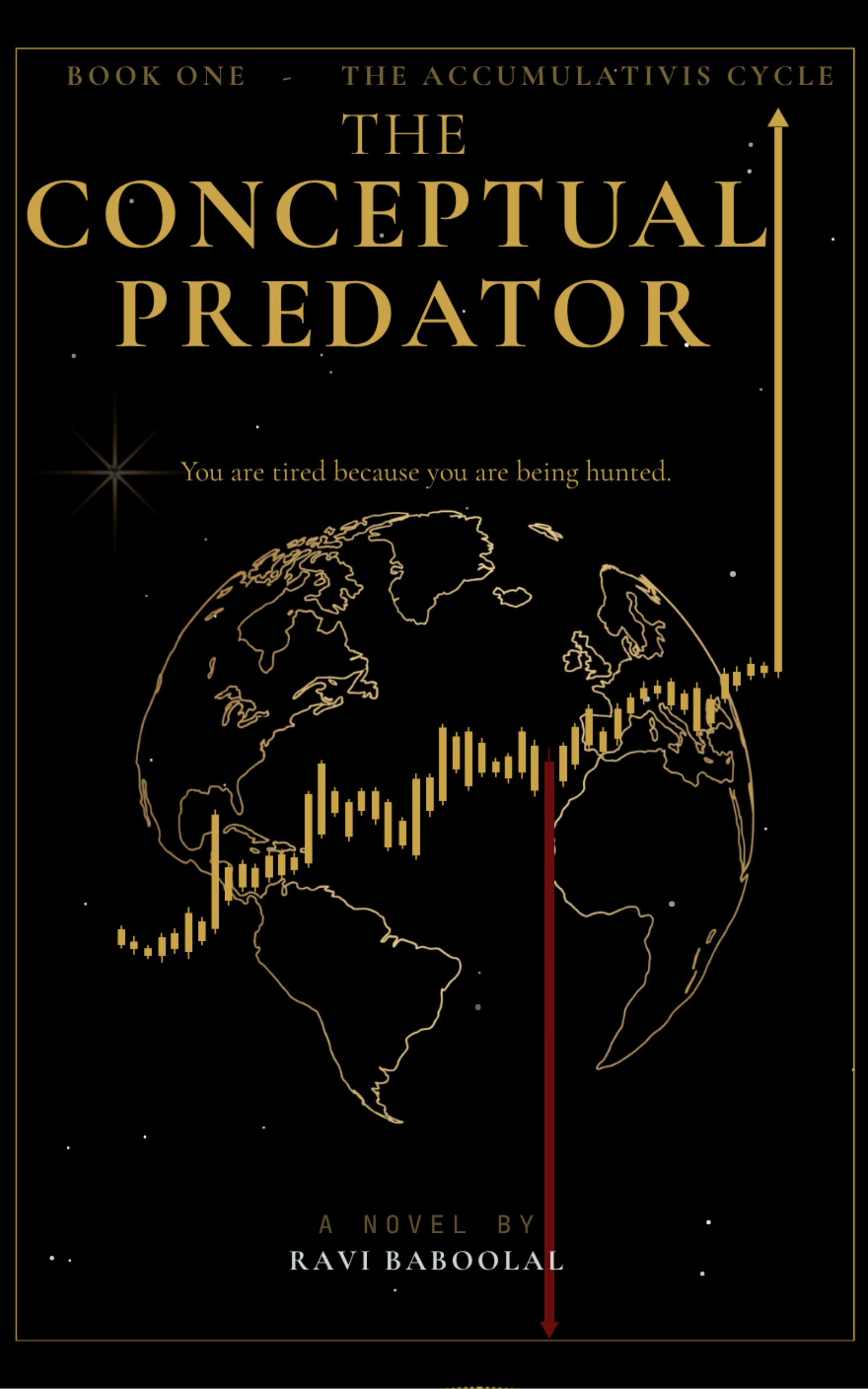
The Conceptual Predator is live on Amazon in paperback and ebook. To mark the release I'll be signing copies at Indigo Cambridge — come say hello, grab a signed paperback, and ask me anything about the audit.
It has no mind, yet you know its logic. You simply call it by another name. The Market.
The Conceptual Predator is a work of cosmic horror written as a forensic audit — a report assembled by outsiders picking through the wreckage of an economy that behaved like a living thing. There is no monster on the page. There is a pattern in the numbers, and the pattern is hungry.
There is no attacker. Only a ledger.
The Sol system was screaming.
That was the first indicator. Before the ship's visual sensors even cleared the Oort Cloud, the Aethel's passive receivers were overwhelmed. It wasn't the orderly, rhythmic pulse of a pulsar, nor the clean, mathematical song of a Type-I civilization. It was pure noise, a chaotic, overlapping, desperate shrieking across every frequency of the electromagnetic spectrum. Zyd adjusted her exoskeleton, the servo-motors humming a low note of irritation against her thorax. She reached down to gently tap at the servo on her left knee, feeling the actuator shudder beneath her fingernail before resettling. The calibration always seemed to drift when she was stressed. A phantom ache, as if the hardware could feel wrongness before the mind could name it. She floated in the zero-gravity of the Observation Blister, her multi-spectral eyes fixed on the distant, pale blue-green dot. The exoskeleton's padding pulsed gently along her spine, a rhythmic nudge designed to regulate her heart rate. It wasn't working. The noise from the system had a texture she couldn't filter: thick, wet, and sour, like standing too close to an overheating environmental scrubber.
"Ping the probe," Captain Ky'rell instructed. His voice was even and controlled. But Zyd had served with him long enough to hear the slight pause between the words — the fraction of a second where a researcher decides whether to open the box and peer inside.
The Sentry had been lurking unseen in the Heliopause for forty local revolutions, hoarding four decades of radio waves, medical telemetry, and digital exhaust. Its initial telemetry had flagged a Tier-0.7 civilization, but the data had been evasive. Every time the Federation's algorithms attempted to categorize the planet's resources, the noise shifted, reorganizing itself to hide the true thermodynamic cost. A mathematical friction that refused to balance.
"Probe docked, uploading now," Zyd replied. The silence that followed was worse than the noise. Zyd drifted, permitting the Sentry's data to wash over her neural link. It hit her cortex like a wave, the information crashing through her defenses and winding paths through her mind. In the heady mix of biological and artificial memory, connections began to form. Neurons and memristors formed clusters; a deluge of biology, culture, history, language and society began to categorize and organize. She absorbed their anatomy, their chemical baselines, their wars. She built a model of a Human in her mind, layering organs, hormones, and neuro-receptors until she understood exactly how the machine should function. The biological schematic was sound and far from unique among the cosmos.
Input: Carbon/Oxygen.Output: Kinetic Motion/Biological processes.
But the system efficiency was impossibly low.
Tap. Tap. Tap.
She opened the neural link, ready to dive into the data stream. Her digits pulsed at the pesky servo as the flow of information slowed from a torrent to a trickle. The model of the Human species stuttered in her mind, its resource flows refusing to resolve into a stable equation.
"The simulation… it's seized up. That shouldn't be possible." She kicked a leg out, using the momentum to spin in place, aligning her optical receptors with the real-time feed scrolling past on the workstation. The pale blue orb spun in the far distance, growing as the Aethel approached. Beautiful and wrong.
"Navigator," Commander Ky'rell said, his voice cutting through the hum of the drive core. "Establish synchronous orbit. Keep us dark." V'lar, the Astronomical Navigator, failed to respond. He was standing at the sensor console, his claws hovering frozen over the controls. V'lar was a heavy-worlder, a long-lived species built for crushing gravity and geological patience. Zyd had watched him navigate asteroid belts without blinking. But now the involuntary tremor in his carapace was visible from across the bridge. His mandibles were pulled tight against his neck, a biological sign of intense, primal distress that Zyd had only ever seen in the historical archives.
"V'lar?" Ky'rell asked, looking up from his workstation. "Status."
"It's… wrong, Commander," V'lar clicked, his voice vibrating with revulsion. "The planet. It is feverish." Ky'rell turned from the command dais. His long, slender fingers went still, an ancient predatory instinct, freezing in place to better access the environment.
"Explain." V'lar threw the visual onto the main hololith.
"I attempted to map the thermal gradient for ideal concealment. But there is no gradient, Commander. Nowhere to hide. The planet is bleeding heat. It is… burning."
"Filter for Infrared," Zyd said. Usually, a biosphere appeared as a soft, cool gradient, a balanced equation of solar absorption and terrestrial radiation. Life was efficient; life hoarded energy. The blue marble vanished. Replaced by a swirling map of angry reds and whites. Earth looked like a dying ember, covered in glowing sores of waste heat, venting terawatts of infrared energy directly into the void. The image burned against Zyd's optical receptors, and her exoskeleton's cooling system engaged involuntarily, a sympathetic response, as if her own body were trying to reject the sheer thermodynamic violence of it. Nobody spoke.
The bridge of the Aethel hung in the silence of the void while the planet screamed in infrared. "The bleed…" Zyd whispered. "Look at the bleed."
"Is it volcanic?" Ky'rell asked, floating closer to Zyd as she entered the bridge.
"No," Zyd said, pulling up a workstation with a gesture. "It's kinetic waste. Commander, this system is leaking energy like a cracked reactor casing." The night side of Earth appeared on the main hololith. She isolated one of the 'sores' of the North American eastern seaboard. From space, humans see New York City at night as a majestic constellation of lights. Zyd saw it differently, through the eyes of a Xenobiologist auditor with over a century of success behind her.
"Look at the light spectrum," Zyd said, her voice dropping. "They are burning millions of years of carbon reserves just to push photons into the empty sky. It serves no function aside from decorative waste."
"That is thermodynamic suicide," V'lar clicked, his mandibles loosening slightly as professional analysis took over from biological revulsion. "Why would a species spend its finite energy reserves to light up the dark? Is there some threat? Perhaps a nocturnal apex predator such as M6-117?" Zyd turned to the Commander.
"Perhaps. That would fit, except that some population clusters lack the infrastructure for mass illumination. If it were predation, it must be regional." Ky'rell stared at the screen. The sheer waste of it was offensive to his Federation sensibilities. Zyd could see his jaw working, the muscle beneath his temple that tightened when he was suppressing an emotional response. Why? Was the only thought he could muster.
She isolated the cluster again and dove deeper. "I am detecting millions of individual combustion events," Zyd analysed. "They are burning long-chain hydrocarbons to generate kinetic motion. But look at the efficiency rating." She let the data linger on the hololith for a moment before she continued, silently hoping someone had another explanation.
"They explode a volatile liquid fuel to push a piston," Zyd explained, her voice dripping with disgust. "But they only capture 30% of the energy as motion. The other 70%? Waste heat. Friction. Noise. They are burning their planetary reserves to warm up the atmosphere."
"Primitive," Ky'rell noted. "But typical for a low-tier civilization."
"It gets worse," Zyd said. "Focus on Sector 4." The image in the hololith spun, settling in on six lanes of deadlocked traffic — thousands of vehicles, engines idling just to keep their drivers cool. Heat shimmered off the tarmac in waves that the Aethel's sensors rendered as a pulsing, angry orange. "They aren't moving," Zyd said. "The engines are running. The fuel is burning. The heat is venting. But the kinetic output is zero." She turned to Ky'rell — the unease in her words a match for the confusion in her mind.
"Commander, if I designed a propulsion system that consumed 100% of its fuel while remaining stationary, you would have me decommissioned for incompetence. It isn't just bad engineering. It's a closed loop of entropy."
The bridge fell silent once more. The crew of the Aethel had seen planetary death before: asteroid impacts, war, world-consuming fungal outbreaks, but those were natural and unavoidable. This felt familiar and deliberate.
The silence stretched until it ached.
"However, that is the minor error," Zyd said, picking up the analysis once more. She accessed the medical partition of the Sentry's data. "The major error is in the blood." She projected a holographic analogue of a Human male onto the hololith. It rotated slowly in the blue light, its systems translucent and exposed. She highlighted the adrenal glands, two small, fleshy caps sitting atop the kidneys. They glowed an angry amber.
"The probe has been sampling their medical transmissions for forty years," Zyd explained. "I have constructed a baseline." She paused. Let the hologram turn.
"Commander, 92% of the adult population currently displays cortisol levels, a primary stress hormone and other trace markers consistent with being hunted by an Apex Predator." Ky'rell looked at the scan. He rubbed his chin slowly, his researcher's mind running through the catalogue of known threats.
"A mega-fauna? Something like the Substrate-Worms of the Canopus System, in hibernation perhaps?"
"No," Zyd said. "They are just… sitting."
The crew of the Aethel turned to her.
She returned the hololith to its view of a Los Angeles highway at rush hour. Thousands of vehicles gridlocked, engines idling, burning fuel to move nowhere. Red taillights stretched to the horizon, a river of heat and misery bleeding into the dark. "Look at them," Zyd whispered. "They burn energy to transport themselves to stationary boxes. Once there, they sit in a stress position — spine curved, neck craned, for eight to ten hours a day. They consume compounds with high caloric density but low cellular utility, triggering rapid dopamine cycles. And while they do this… their hearts race. Their bodies flood with stress hormones. They are terrified and don't even know it."
V'lar looked at the screen, at the red taillights stretching for miles. His carapace had grown pale, a heavy-worlder's involuntary camouflage response. His body was trying to hide from something that wasn't in the room.
"Terrified of what? It looks like a mass exodus," V'lar said. "Like they are escaping some natural disaster. But they just aren't moving."
"Exactly," Zyd replied. She turned to Commander Ky'rell. "A species does not self-destruct like this without a driver," Zyd theorised. "Animals do not poison their own nest unless forced. They do not starve themselves of sleep unless hunted. But there is no animal on the scanner large enough to cause this behaviour. Humanity is the dominant lifeform by a significant margin. Where are they going? Why is it so important that they might poison themselves and their environment to get there?"
Ky'rell looked back at the glowing, burning Earth. He looked at the humans in their cars, their eyes wide, their blood thick with the chemicals of fear, terrified of something that didn't appear on any sensor.
"They are offering up their biosphere to something, Zyd," Ky'rell murmured. "They are suffering to appease a cultural element, or perhaps a deity. Something that demands this… level of self-destruction." He turned to her. His eyes, normally soft with the quiet curiosity of a researcher, had gone hard.
"Find it. I want to know if we are dealing with a mega-fauna we can't see, a viral agent, a religious ceremony or a mass hysteria event. Catalogue the threat." Zyd nodded. She turned back to the console and began to filter the radio static, looking for the roar of the beast.
She found a rhythm, a machine-gun stutter of data. Trillions of bytes per second. Algorithms fighting algorithms, a heart in atrial fibrillation. In the noise, thousands upon thousands of voices shouted into the cosmos for attention — not cries for help, but prayers, begging for validation or demanding transaction.
It wasn't the roar of some beast. It was a ledger.
Zyd opened a new file labelled ANOMALY SEARCH.
She didn't know the monster's name. She only knew that it was hungry and on the hunt.
LOG 1.0 // END
End of Chapter One.
Short-form transmissions from the edges of the Cycle — case files and side-ledgers that don't fit the main audit. Standalone dread, read in one sitting.
The audit becomes a chase. A starving crew aboard The Dismal Science learns that when the ledger runs empty, mass is the only currency left — and every debt is paid in body weight. Newton is an unforgiving god.
Read a scene — The Blasphemy of MassThe hypothesis paper behind the novel: an argument that a predatory economy is an endogenous Great Filter — a civilization consumed not from outside, but by the emergent logic of its own accounting.

Ravi Baboolal is a robotics and AI systems engineer based in Cambridge, Ontario, and the founder of BotBrawl, Canada's combat-robotics league. A Dungeon Master of over a decade, he writes horror that hides in systems — the kind you don't notice until it has already priced you in.
The Conceptual Predator is his debut novel, conceived and written in six months.
Full bio & the Indigo Cambridge event →